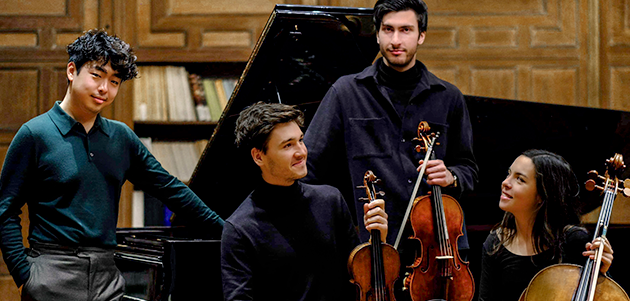
en résidence depuis 2023
- Vassily Chmykov violon
- Paul Zientara alto
- Stéphanie Huang violoncelle
- Kojiro Okada piano
Vassily Chmykov violon
Vassily Chmykov est un violoniste français né à Monaco en 1999.
Il débute le violon au sein de l’Académie de Musique du Prince Rainier III de Monaco dans la classe de violon de Margarita Guerchovitch puis il poursuit ses études au CNSMD de Paris dans la classe d’Alexis Galpérine en cycle d’études Master et également à Lausanne en Master Soliste dans la classe de Pavel Vernikov et Svetlana Makarova, où il a eu la chance d’enregistrer son premier disque en duo Violon Guitare durant l’année 2023 avec Benoît Mussard et le label suisse Claves Records.
Il s’est déjà produit en tant que soliste et chambriste dans de nombreux pays notamment en France, Russie, Japon, Monaco, Allemagne, Italie, Suisse et Autriche, accompagné d’éminents orchestres dont l’Orchestre Philharmonique de Monte-Carlo, l’Orchestre national d’île-de-France, l’Orchestre des lauréats du CNSM de Paris, l’ensemble Artis, l’Orchestre Philharmonique de Krasnoïarsk et Novosibirks; et dans des salles prestigieuses comme le Théâtre des Champs-Élysées, la Salle Cortot ainsi que la Fondation Louis Vuitton à Paris, la Konzerthaus de Vienne, l’Auditorium Rainier III et Grimaldi Forum de Monaco ou encore le Victoria Hall de Genève.
Vassily est également sollicité à se produire au sein d’orchestres français (l’Orchestre de Chambre de Paris, l’Orchestre National de Lille, l’Orchestre National de Bretagne, l’Orchestre de l’Opéra de Rouen, l’Orchestre de Paris, l’Orchestre Philharmonique de Monte-Carlo…).
Artiste invité dans de nombreux festivals de musique de chambre en France comme à l’étranger, on peut citer le Festival de la Kronberg academy, le Festival de Pâques de Deauville, l’Orangerie de Sceaux, le Festival Pablo Casals, l’Académie Jaroussky, Seiji Ozawa International Academy (Suisse), Seiji Ozawa Matsumoto Festival (Japon), le Festival des Arcs, le Festival de Saint-Cezaire, le festival de Giverny, le Centre de Musique de Chambre de Paris, le festival de Musique de Chambre d’Entrecasteaux.
Vassily a participé à des Masterclasses et partagé la scène avec de nombreux artistes internationaux tels Augustin Dumay, Michaela Martin, Svetlin Roussev, Laurent Korcia, Boris Garlitsky, Pamela Franck, Pavel Vernikov et Svetlana Makarova.
Dans son palmarès, il a été lauréat et récompensé de plusieurs prix internationaux : 1er Prix du IXème Concours International de violon Alexandre Glazounov, Prix du Prince Albert II de Monaco, 1er Grand Prix au Concours International Intercordes à Paris, le Prix de la Kronberg academy « Ana Chumachenco ».
Paul Zientara alto
Nommé à 20 ans Révélation Classique de l’ADAMI 2021, Paul Zientara est lauréat de plusieurs concours internationaux : 3ème prix du prestigieux Concours Lionel Tertis sur l’île de Man, Grand Prix de la Fondation Safran, 1er prix du Concours de Cordes d’Epernay, 3ème prix du Festival Musical d’Automne des Jeunes Interprètes…
Il débute l’alto à l’âge de 7 ans avec Yves Pruvot au Conservatoire de Yerres. Après deux années au CRR de Paris dans la classe de Françoise Gnéri, il est admis à l’âge de 16 ans au Conservatoire National Supérieur de Musique de Paris dans la classe de Sabine Toutain et Christophe Gaugué. Paul a eu l’occasion de se perfectionner auprès de maîtres tels Tabea Zimmermann, Gérard Caussé, Tatjana Masurenko, Lawrence Power, Nobuko Imai, Bruno Pasquier, Nils Mönkemeyer, Claire Désert, le Quatuor Ebene, Laurent Korcia…
Il participe régulièrement à différentes académies et masterclasses internationales dont la Kronberg Academy Festival (pour laquelle il a été recommandé par Tabea Zimmermann), Anton Rubinstein Academy de Düsseldorf, Internationale Musikakademie du Liechtenstein…
En 2022, il se produit en soliste dans la Symphonie Concertante de Mozart pour violon et alto avec Renaud Capuçon et l’Orchestre National du Capitole de Toulouse. Ses débuts en soliste sont marqués par le Concerto de Bartók avec l’orchestre Pasdeloup à l’âge de 16 ans, suivis de multiples expériences en soliste avec orchestres tels que l’Orchestre de la
Garde Républicaine, L’Orchestre Colonne, la Nouvelle Europe…
Parmi ses partenaires de musique de chambre citons Renaud Capuçon, Gérard Caussé, Nelson Goerner, Valeriy Sokolov, François Salque, Pierre Fouchenneret, Jérôme Pernoo, Marc Coppey, Adam Laloum, Emmanuel Strosser, Adrien Boisseau, Liya Petrova, Adrien La Marca,
Jérôme Ducros, Jérémy Menuhin, Victor Julien-Laferrière, Nicolas Baldeyrou…
Il s’est produit notamment au Festival de La Roque-d’Anthéron, au Festival de Pâques d’Aix-en-Provence, de Deauville, de Colmar, au Festival de la Grange de Meslay, au Centre de Musique de Chambre de Paris, aux Pianissimes, au Festival Idéal au Potager du Roi de Versailles, au Festival Pablo Casals à Prades, avec le Collectif Fractales…
En novembre 2021, il est invité par Renaud Capuçon au festival Nouveaux Horizons où il interprète entre autres diverses créations contemporaines dont une œuvre de Diana Soh en duo d’altos avec Gérard Caussé.
Il joue régulièrement en duo avec l’organiste Vincent Warnier qui a récemment composé « Légende », œuvre pour alto et orgue dont Paul est le dédicataire. Ils en ont interprété la création en octobre 2020.
En 2021, Michel Le Naour lui consacre un article dans le magazine Classica, et en 2022, Benoît Fauchet dans le magazine Diapason. Il apparaît aussi dans d’autres médias comme France Musique, Radio Classique, Le Figaro, Arte Concert, Ouest-France…
Il est membre du Quatuor Phantasy avec hautbois, du Duo Atlas dans l’Association Jeunes Talents avec Vassily Chmykov et du collectif créé par Emmanuel Coppey, Paris Youth Music Society.
Il intègre Beau Soir Productions dès sa création, ce qui lui permet de travailler avec Renaud Capuçon et ses équipes.
Paul joue sur un alto de Patrick Robin, financé par la Fondation Safran pour la Musique, à l’initiative de l’association TALENTS & VIOLON’CELLES.
Stéphanie Huang violoncelle
Lauréate du Concours musical international Reine Elisabeth de Belgique 2022 où elle remporte également les deux prix du public (le prix Canvas-Klara et le prix Musiq3), Grand Prix du Concours international de violoncelle Suggia 2015 à Porto, Premier Prix du Concours international de la Società Umanitaria 2021 à Milan, nommée Révélation ADAMI Classique 2021 en France, Stéphanie Huang a marqué son parcours musical par sa passion et son sens du perfectionnisme.
En janvier 2025, elle rejoint l’Orchestre de Paris au poste de premier violoncelle solo. Elle est également professeure au Koninklijk Conservatorium van Brussel depuis septembre 2024.
Elle a joué en soliste avec l’Orchestre Philharmonique de Strasbourg, l’Orchestre Symphonique de Mulhouse, le Munchner Rundfunkorchester, l’Orquestra Sinfonica do Porto, le Brussels Philharmonic, l’Orchestre National de Belgique, l’Orchestre de Chambre de Wallonie, sous la direction de Renaud Capuçon, Augustin Dumay, Pierre Dumoussaud, Michael Sanderling, Stéphane Denève, Joana Carneiro, James Feddeck. Elle joue régulièrement dans de nombreux festivals nationaux et internationaux (Evian, Deauville, La Roque d’Anthéron, Biot, Verbier, Gstaad, Bruxelles, Schiermonnikoog, Helsinki…) avec Renaud Capuçon, Sylvia Huang, Paul Zientara, Anna Agafia, Gérard Caussé, Guillaume Bellom, Keigo Mukawa…
Née en Belgique dans une famille de musiciens, Stéphanie Huang commence le violoncelle dès son plus jeune âge. Elle a remporté un premier Prix au Concours Dexia et fait ses débuts à l’âge de douze ans au Théâtre Royal de la Monnaie à Bruxelles dans les Variations sur un thème rococo de Tchaïkovsky. Après avoir obtenu en 2017 sa licence au Koninklijk Conservatorium de Bruxelles avec Jeroen Reuling, elle a poursuivi ses études avec Marc Coppey et Emmanuelle Bertrand (musique de chambre) au Conservatoire National Supérieur de Musique et de Danse de Paris, et Gary Hoffman (Chapelle Musicale Reine Elisabeth) avec de nombreuses récompenses (fondations Spes, Meyer, Kriegelstein, Safran, Banque Populaire).
Elle joue sur un violoncelle Jean-Baptiste Vuillaume généreusement prêté par le Fonds de Dotation Adelus.
Kojiro Okada piano
Né en 1999 à Bordeaux, Kojiro Okada débute le piano à l’âge de sept ans.
Il se produit dans les plus grandes salles à Paris, en 2010 à la Salle Pleyel à l’occasion du bicentenaire de Chopin, en 2013 au Théâtre du Châtelet pour un concert caritatif intitulé « Tous en cœur », en 2022 à la Philharmonie de Paris, ainsi que de nombreux concerts à la Salle Cortot. En 2022, il participe à une tournée aux Etats-Unis et au Canada où il partage la scène avec Miguel da Silva à la Salle Bourgie à Montréal et la « Philipps Collection » à Washington.
Il est régulièrement invité par de nombreux festivals tels que le festival Chopin à Nohant, le festival de l’Orangerie de Sceaux, le festival des Musiques au Pays de Gabriel Fauré, le festival international de Piano de la Roque d’Anthéron, les Folles Journées de Nantes, les Sommets Musicaux de Gstaad, le festival Beethoven à Flagey…
Ainsi, il partage la scène avec de grands artistes tels que Nicholas Angelich, Jean-Efflam Bavouzet, François-Frédéric Guy, Claire Désert, Emmanuel Strosser, Marie-Josèphe Jude, Frank Braley, Miguel da Silva, Yves Henry, Dag Jensen, Jean-Philippe Collard, Bruno Philippe, Gary Hoffman.
Après avoir étudié au CNSMD de Paris dans la classe de Hortense Cartier-Bresson et Florent Boffard, il se perfectionne actuellement à la Chapelle Musicale Reine Elisabeth auprès des pianistes Frank Braley et Avedis Kouyoumdjian.
Soutenu par la Fondation Banque Populaire et la Fondation Safran, Kojiro Okada est récompensé de prix internationaux comme soliste et chambriste, premier prix du Concours International Gabriel Fauré, premier prix du Concours International de la Società Umanitaria à Milan (duo) et lauréat du Concours International « Classic Piano » à Dubaï.
En 2024, il rejoint le Trio Pantoum.